Thursday, August 15, 2019

Movie Night: Portrait de la jeune fille en feu

Come along to see "Portrait de la jeune fille en feu" (Portrait of a Lady on Fire) a romantic film set in the 18th century starring Adèle Haenel, Luana Bajrami, Noémie Merlant, Valeria Golino that take home Best Screenplay and the Queer Palm at Cannes. Tickets just under $20 for students. 

Where:  Hoyts Melbourne Central
When: Friday 16 August at 9:30

Book or view trailer here: http://miff.com.au/program/film/portrait-of-a-lady-on-fire? 


More information about where to meet up will be posted here:

Tuesday, August 6, 2019

General Meeting 13th August 11am

The LTU French Club is back for the second semester of 2019! Our first meeting will be taking place Tuesday 13th of August from 11am-12pm in TLC-201. There'll be snacks! (Send a message to our facebook page if you have any particular food requirements or preferences).


Le club de français est de retour pour le deuxième semestre de 2019! Notre premier réunion aura lieu mardi 13 aout de 11h à 12h dans TLC-201. Il y aura des casse-croutes! (Envoyez un message à notre page facebook si vous avez des besoins or preferences alimentaires).


Tuesday, May 28, 2019

.fr .au The Australian and European elections (1)


Elections this May for two unions at opposite ends of the world: Australia, a federation that has lasted for more than a hundred years, and the European Union - which also has a long history - being founded by the treaty of Rome in 1958. But despite the physical distance between these elections, the underlying tensions are not so different after all.

Start with the voting method, the European Parliament with its 751 seats, et 28 member states, and the Australian Parliament with 226 seat, six state and two territories, both have difficulty integrating the democratic necessity to gave power to a majority but still to allow minority voices to be heard. Each has a different solution...

The "Old Continent"


File:Pape François Parlement européen Strasbourg 25 nov 2014 18.jpg
The European Parliament in Strasbourg ©*
In Europe, all the states divide up the seats in a way that is degressive and proportional: that to say each state is accorded seats in function of their population (more people = more seats) but as the population of a country increases, the additional number of seats is reduced.

So populous countries like Germany, Italy, France or (for now) the United Kingdom don't dominate the Parliament, and little countries (who are guaranteed at least six seats) have at least a presence. 

All of these countries can select their voting method if it respects the rule of proportionality: France today therefore has a single electorate taking in the whole country with a list system (where political parties produce lists of candidates and electors vote for a(n entire) list), but from 2004 to 2014 had instead eight regional circumscriptions of the same size.

The other end of the world...

File:Parliament House at dusk, Canberra ACT.jpg
The Australian Parliament ©*
In Australia, representatives of the country are divided into two houses: one, the House of Representatives, has 150 seats distributed nearly equally so that each seat has the same population, and the other, the Senate, has 76 seats, 12 for each state and two for each territory (and note that Tasmania receives at least five seats in the House of Representatives).

Each MP of the House of Representatives is elected by a preferential majority 
(meaning that it's not proportional) and each Senator is elected proportionally and preferentially. 

At the national level, compulsory voting was put in place in 1924 after a rather low participation rate in an election.  Today participation rate remains high thanks to this compulsion but also thanks to other measures taken to favorise voting by all - for example: élections occurring exclusively on weekends and AEC publicity funded by the government. Even if democratic enthusiasm declines like in Europe, the numbers are truly very far from the 57% non-voting rate in the 2014 European Elections.

Why such a difference? Some would raise the difficulty of understanding the multitude of European authorities, or the lack of compulsory voting (although Belgium and Luxembourg diverge from the norm in this area also), the reject of supranational organisations, or even . Whatever the reason, the solution is hard to find.

.fr .au is a series of articles that compare Australia and France available in French and in English. Version française ici. The next article will look at the Australian election results...

*The images:
(1) Lien 
(2) © Claude Truong-Ngoc / Wikimedia Commons Lien 
(3) © Thennicke Lien 

For more information:

Friday, May 10, 2019

.fr .au Les élections européennes et australiennes (1)


Des élections en ce mois de mai pour deux unions qui se trouve à deux bouts de monde complètements opposés : L’Australie, une fédération qui a duré plus de cent ans, et l’Union Européenne - qui aussi a une histoire de longue durée - étant fondé par la traité de Rome en 1958. Mais en dépit de la distance physique entre ces élections, les enjeux qui les animent, ne sont pas si différents après tout

Commençons par le mode de scrutin, le Parlement Européen avec ses 751 sieges, et 28 pays membres, et le Parlement Australien avec 226 sieges, six états fédérés et deux territoires, ont, tous les deux, du mal à intégrer le besoin démocratique de donner le pouvoir à la majorité et pourtant de laisser entendre les voix minoritaires. Chacun montre une solution différente. 

Le "vieux continent" 


File:Pape François Parlement européen Strasbourg 25 nov 2014 18.jpg
Le parlement européen à Strasbourg ©*
En Europe, tous les pays se partage les sieges d’une façon dégressive et proportionnelle: c’est-à-dire chaque pays est accordé des sieges en fonction de leur population (plus de gens = plus de sieges) mais tant que la population augmente, le nombre additionnel de sieges est
réduite. 

Alors les grands pays comme l’Allemagne, L’Italie, la France ou (pour l’instant) le Royaume-Uni ne dominent pas le parlement, et les petits pays (qui sont garantis au moins six sieges) ont au moins une présence. 

Tous ces pays ont le pouvoir de choisir leur mode de scrutin en respectant la règle de proportionnalité: La France aujourd’hui donc a une circumscription unique qui comprend tous le pays et une système de liste (où les parties politique produit les listes de candidats et les électeurs votent pour une liste entière), mais de 2004 à 2014 a eu huit circonscriptions régionales de meme taille. 

A l'autre bout du monde...
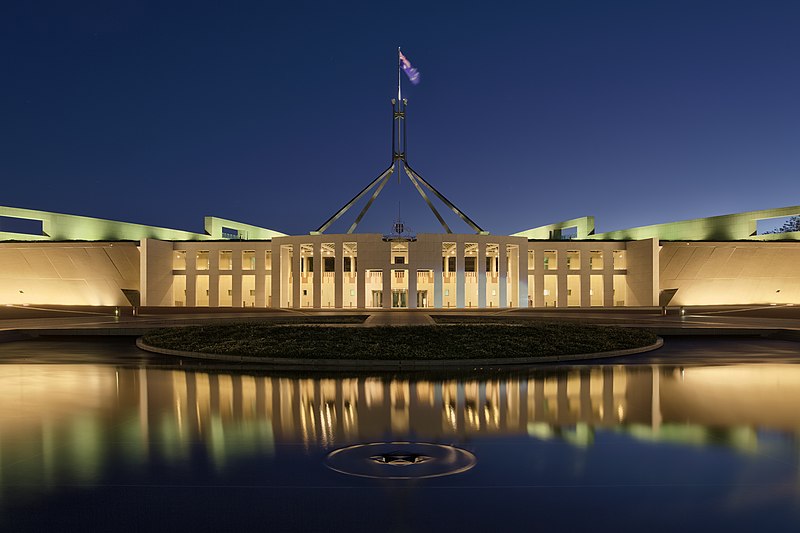
File:Parliament House at dusk, Canberra ACT.jpg
Le parlement australien ©*
En Australie, les représentants du pays sont divisé en deux chambres: une, the House of Representatives, ayant 150 sieges repartis presque de manière égalitaire afin que chaque siege ait une population égale, et l’autre, le Sénat ayant 76 sieges, douze attribués au chaque état fédéré et deux au chaque territoire. (Notons qu’il y a une seuil minimum de cinq sieges accordé à la Tasmanie dans le House of Representatives.)

Chaque député du House of Representatives est élu par un vote majoritaire préférentiel (mais pas proportionnelle) et chaque Sénateur est élu proportionnellement et préférentiellement. 

Au niveau national le vote obligatoire a été mis en place en 1924 après un taux de participation au scrutin qui était plutôt bas.  Aujourd'hui le taux de participation reste élevé grâce a cette obligation mais aussi grâce aux autres mesures pris pour favoriser le vote par tous- par exemple: les élections se déroulant exclusivement sur les week-ends et la publicité électorale financé par le gouvernement. Meme si l'enthousiasme décline comme en Europe, les chiffres sont effectivement très loin de le taux d'abstention de 57% dans les élections européennes de 2014. 

Pourquoi une telle différence? Certains évoquent la difficulté de comprendre les multiples instances européennes, le manque de vote obligatoire (notons que la Belgique et le Luxembourg font figure d'exception dans ce matière), le rejet des organismes supranationaux, or meme la dominance des enjeux et partis nationaux. Quelle que soit la raison, la solution reste difficile à trouver...

.fr .au est une série d'articles qui compare l'Australie et la France disponible en français et en anglais. English available here.

*Les images:
(1) Lien 
(2) © Claude Truong-Ngoc / Wikimedia Commons Lien 
(3) © Thennicke Lien 

Pour plus d'info:


Sunday, April 14, 2019

French Talk Week 7!

Bonjour tous le monde! Venez, parlez français at French Talk! on this Thursday 18th of April from 4-5pm in TLC-301. All welcome!!!

Et pourquoi pas parler français entre des amis, ce n'est pas mauvais pour la santé après tout! Trouvez-nous au TLC-301 de 16h à 17h sur ce jeudi 18 avril.


 Les semaines passés on a parlé de deux chansons superbes:
Nos vies parallèles d'Aggun et Florent


Celle-ci est une chanson qui parle de deux amants séparés physiquement mais toujours connecté par la pensé.
Et Plus tard de Big Flo et Oli

Celle-la parle de la dissonance entre la perspective simple de l'enfant qui croit que les adultes ont tous les réponses et la perspective de l'adulte qui n'a pas réponses aux questions enfantines. Ce qui est notable, c'est que l'adulte et l'enfant sont le même personne, divisé dans le temps

Sunday, March 31, 2019

Week 5: French Talk!

Bonjour tous le monde! Venez, parlez français at French Talk! on this Thursday 4th of April from 4-5pm in TLC-301. Open to everyone.

Apologies for the lack of events last week: a lack of advance planning got in the way. 

Saturday, March 16, 2019

Week 3: French Talk + Les Frères Sisters

Bonjour tous le monde! 

Here's what we have on this week:


French Talk is on Wednesday 20 March from 5-6pm in TLC-301 and on Thursday 21 March 4-5pm in TLC-301. French Talk is our session for French conversation, all are welcome to come along and parler français!

And... our first cultural event of the year: a Film Night at Palace Westgath seeing Les Frères Sisters (Brothers Sisters) a film being shown as a part of the Alliance français French Film Festival on Friday March 22, 8:40pm. Buy tickets here. (NB: this film is in English not French with English subtitles.)

 You can find out more in an SBS interview with the director here

Le recap'
On Wednesday the culture piece was Julien Doré's music video Porto-Vecchio! Le theme était des souvenirs du passé et les émotions qu’ils évoquent. La tristesse, l’espoir, le bonheur: notre relation avec le passé peut être compliqué. You can watch le clip officiel here: https://youtu.be/Q9mTyeKUtsk
 

Tuesday, March 12, 2019

French Talk Wednesday 13 March + Vote for Times

Come along and parlez français in our first French talk event of the year! On tomorrow in TLC-301 from 11AM-12PM.

Vote for times

You can now vote on times for French Club events. Click here and paint over the times that suit you. For weekdays click on the times you would go to regularly and for weekends select the times that would be good for special events.

Saturday, March 9, 2019

AGM After Action Report


Many thanks to all who came along to Thursday's French Club AGM! Seventeen people attended, exceeding the quorum of ten. A report was presented on last year’s activities and a new Committee was elected.*
 

The 2019 Committee is made up by:

President Robert Brown 
Vice President Connor Callister 
Treasurer Wenjing Yu 
Secretary Matt Thomas 
Council Delegate Valerie Nizette-Wiseman

We are all hugely excited about the forthcoming year of French Club outings, events, film screenings and hopefully much, much more! (And we authorized spending for La Petite Bibliotheque and  events).

Remember, we are always excited to hear from any French Club members, so please don’t hesitate to comment below or on our Facebook page with your ideas for future French Club events or activities (or to talk to us in person!)
 

Vote for times

You can now vote on times for French Club events. Click on this link to access Whenisgood and paint over the times that suit you. For weekdays click on the times you would go to regularly and for weekends select the times that would be good for special events.
 
*If you want to see the Annual Report it's hosted on our Facebook Group Page. Or you could try to contact the committee.

Thursday, March 7, 2019

Reminder: AGM today

Reminder: French Club AGM is on Today 🇲🇫

When?
1-2pm

Where? ↗️
Library Collaboration Room 2-22 (See a map of the second floor of the library here)

What? 👏 👏 📅 💵
Our Annual General Meeting: we’re decide what we’re going to do, how we spend our funds and officially count members.

(Update: here's the room set up early)